
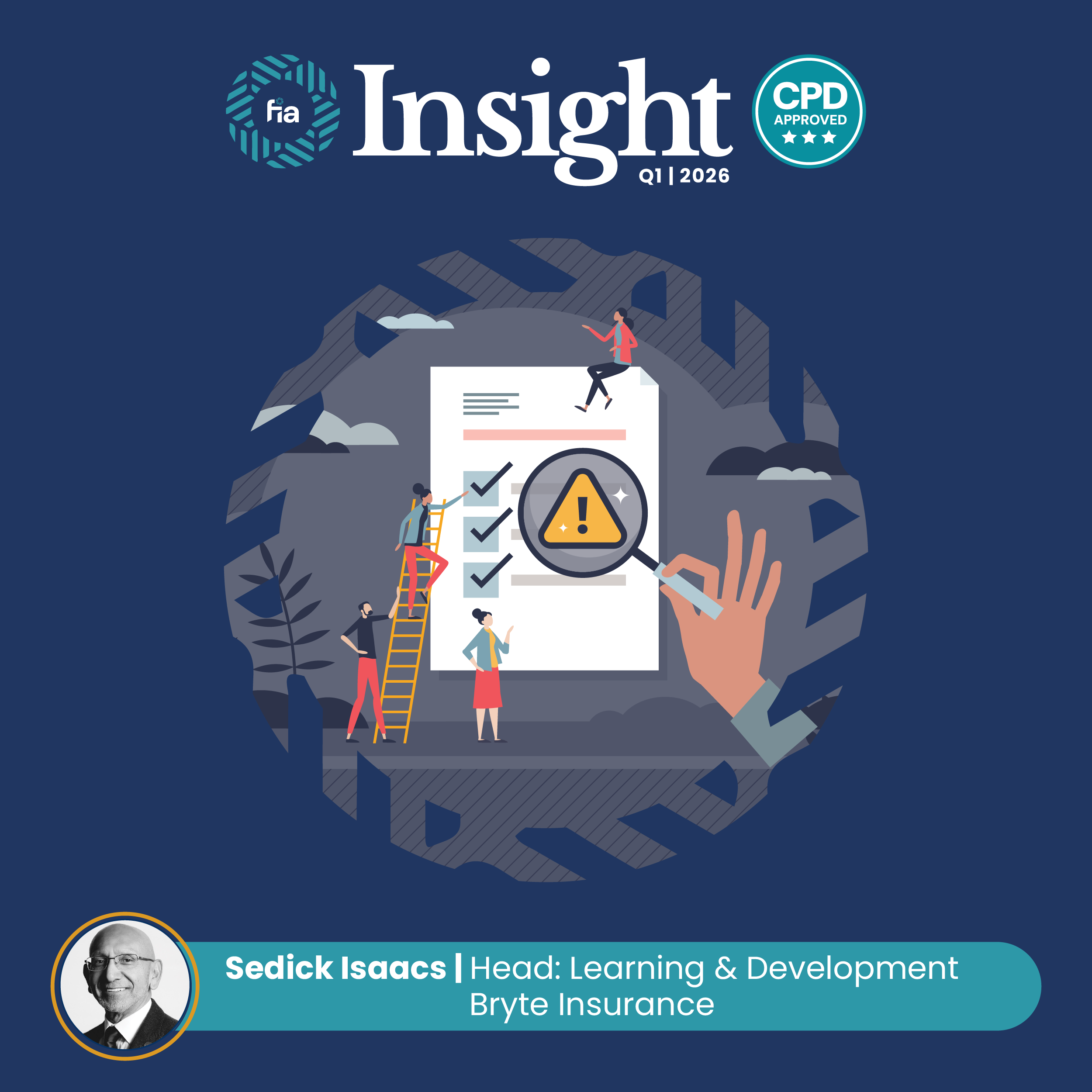
As individuals and organisations, large and small, we live and work with risks daily. Every part of life has a level of risk, both on a domestic level and in business, where internal and external operating environments face risk. How we deal with these risks is of paramount importance. On a domestic level, we face risks in our normal daily functions in our homes when, for example, using a stove or gas apparatus. In business, the risks we take in insurance need to be understood, as at some point, there may be a claim or a business that participates in a specific type of industry that requires consideration for their specific exposure to risk.
Understanding risk management
We know that there is risk in life, but what is more important is understanding how risk management can minimise, avoid, or remove risk. Risk management is a process that uses a methodology to identify risks that organisations face. It then enables an understanding of the effect and impact it will have on an organisation if it takes place.
Once we thoroughly understand the risk, we then analyse and assess it to ascertain how it can affect the organisation and consider what mitigation measures need to be implemented to manage risk, where it cannot be eliminated. Risk management is critical as most risks cannot be eliminated, but constant management and controls must be in place to minimise and sometimes avoid them.
Businesses mustn’t treat risk management as a once-off, but rather as an ongoing programme of continuous management and control. Risks evolve in the modern world with new risks constantly emerging, making it critical for risk management to evolve.
Implementing a risk management programme
When implementing a risk management programme that carries strategic significance for the organisation, we look at how this will deliver strategic success in various key aspects.
When risks are strategically managed, it allows for easier decision-making processes to be implemented at various organisational levels. This promotes opportunity for growth, expansion, and success. But more importantly, it allows for sustainability.
Multilevel decision-making at individual, management and executive levels is critical to an organisation, particularly in the insurance industry. Risk management should therefore enable and be a catalyst for informed decision-making at these various levels.
Protecting reputation
The insurance industry relies on historical data for business planning, directly affecting individual clients and businesses. Therefore, risk management at a strategic level allows for short-term and long-term business planning. Because the risks are known, it allows for solid planning with the ability to consider innovative actions and create a business that will not only withstand risk but will become resilient for a sustainable existence.
Similarly, strategic risk management has a major impact on the reputation of a business. A strong risk management programme allows for customer confidence and strengthens the business’s brand.
Risk mitigation is a direct factor in a business’s ability to grow, expand, and be profitable. A negative view of any organisation is a serious risk to its reputation and will impact the entire business and its profitability. A negative reputation cultivated by a lack of trust and confidence could lead to serious financial repercussions. In contrast, a formidable reputation will give the company good standing compared with its competitors and allow it to explore opportunities and new ventures.
In this digital age, risk management and emerging risks cannot be treated with a tick box approach, as that approach could carry profound consequences for an organisation and its people. Businesses and individuals live in a world where technology is integral to their lives. With the rapid and ongoing technological change, organisations must view risk mitigation as part of their strategic direction and with a long-term future approach. It is the one key aspect for business success that cannot be taken for granted and needs intense and continuous focus and management.
To conclude, risk management mitigates and controls risk, allows companies the freedom to take risks, grows and expands business, increases profitability, implements eco-linked policies, provides for long-term employment opportunities, and serves customers strategically in the short and long terms.