The birth of gap cover
During the early to mid-1990s, tension escalated between specialist associations aligned with the South African Medical Association (SAMA) and the Board of Healthcare Funders (BHF) over the adequacy of the published scale of benefits. Specialists argued that scheme tariffs no longer reflected the true economic cost of modern, high-skill practice. Medical schemes, however, defended a common tariff as essential for affordability and cost control.
As this stalemate persisted, many practitioners increasingly relied on the SAMA Guide to Fees, making charges above scheme tariffs common well before any formal regulatory intervention.
By the mid-1990s, a permanent gap had formed between scheme reimbursement and provider pricing. This gave rise to the introduction of gap cover, initially a modest, low-cost group risk product (R20 to R25 per month) with limited utilisation.
Over time, however, utilisation escalated dramatically. Per-policyholder gap claims have since increased more than 30-fold, transforming gap cover from a minor shortfall product into a central pillar of private healthcare funding.
The evolution of gap cover
As exposure increased, gap cover itself evolved. What began as a modest group-based indemnity for occasional tariff differences developed into a more structured and responsive product category. Benefit limits expanded, underwriting sophistication improved and insurers adapted pricing to reflect rising utilisation. Gap cover shifted from a peripheral add-on to a recognised component of healthcare risk management. By the 2010s, it was no longer a niche product; it had become a standard part of private healthcare funding.
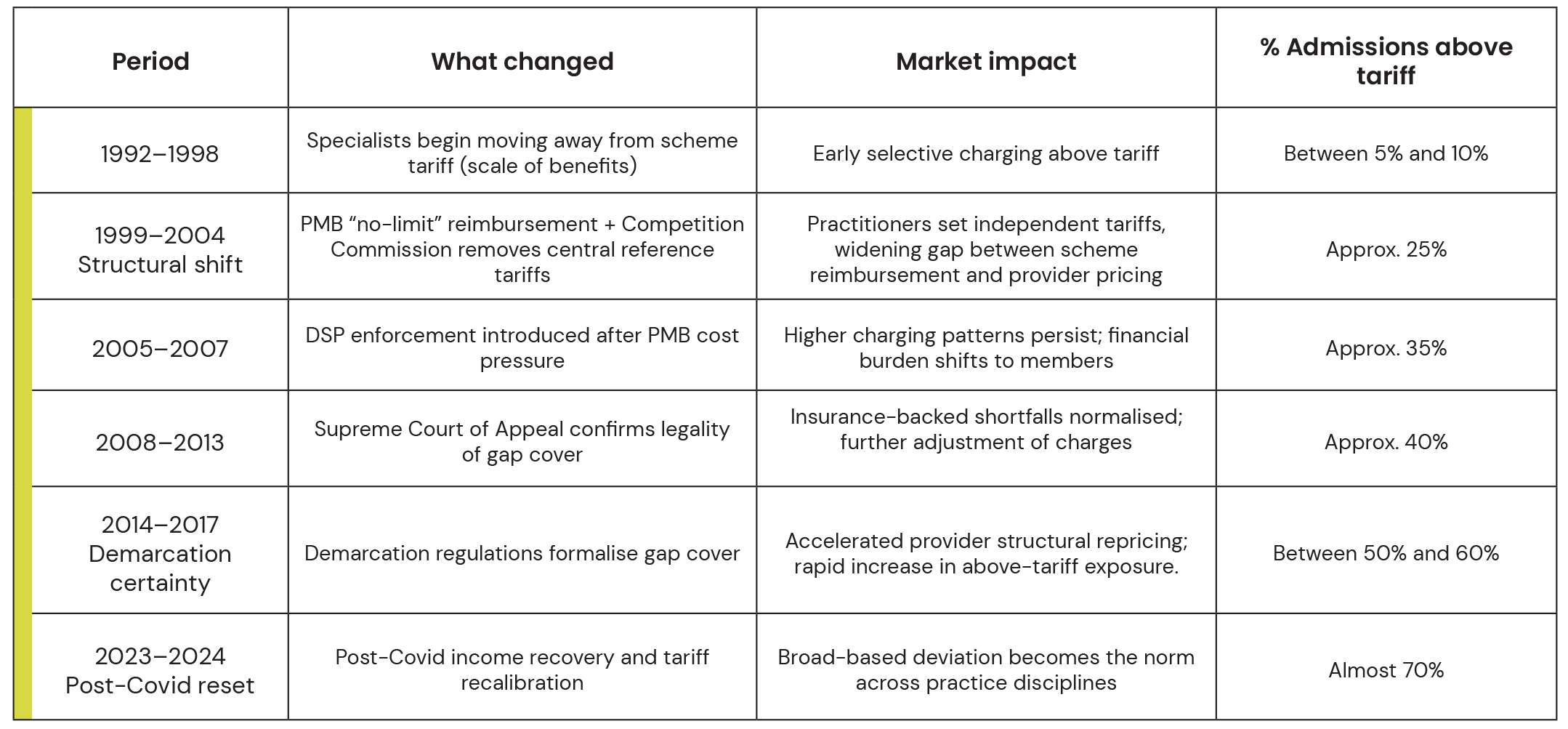
The gap between what medical schemes pay and what specialists charge did not widen overnight. It was shaped by four major turning points. The first was the introduction of prescribed minimum benefits (PMB) and a Competition Commission ruling in the early 2000s. Together, these events removed central tariff benchmarks and allowed specialists to move away from scheme tariff as the primary pricing reference. That was the foundation. Once independent tariff setting became normal, the gap began to widen.
The second and third turning points were the demarcation regulations in 2016 – 2017 and the post-Covid adjustment period in 2023 – 2024. Demarcation removed the uncertainty around the legality of gap cover and many practitioners adjusted their pricing accordingly. The Covid period then disrupted specialist income, and the recovery phase saw further tariff increases. These episodes accelerated the departure from scheme tariff for many disciplines. Together, they explain why the gap that began gradually in the 1990s has now become embedded in the system.
Viewed collectively, the trajectory is obvious. From less than 5% of admissions attracting tariff shortfalls in the early 1990s, exposure rose incrementally through regulatory disruption, legal recalibration and behavioural adaptation to approximately 25% in the early 2000s, 35 to 40% by the post-SCA adjustment period, over 60% following demarcation certainty, and ultimately to approximately 70% in 2024.
This change shows a long-term shift in the healthcare system, not just temporary market fluctuations.
The gap between what schemes pay and what specialists charge is now part of the system. Many specialists currently charge around two times scheme tariff, which most clients may view as reasonable. However, there is no longer a benchmark that limits how far those multiples can move. If economic pressures increase again, or if another shock occurs, some disciplines could move to four or five-times tariff. In an environment where most hospital admissions already include above-tariff charges, even modest increases in these multiples would significantly increase the financial impact on members.
Understanding these dynamics is therefore becoming an important part of healthcare planning for both individuals and employers. Taking this evolution into consideration, gap cover should form a key element of a person’s health insurance plan and because this is a risk rated insurance product, there can be both cost and underwriting benefits if gap cover is offered as a benefit via an employer group.
The table below traces how these events unfolded over time, and how each era incrementally increased the probability of charges above scheme tariff.