
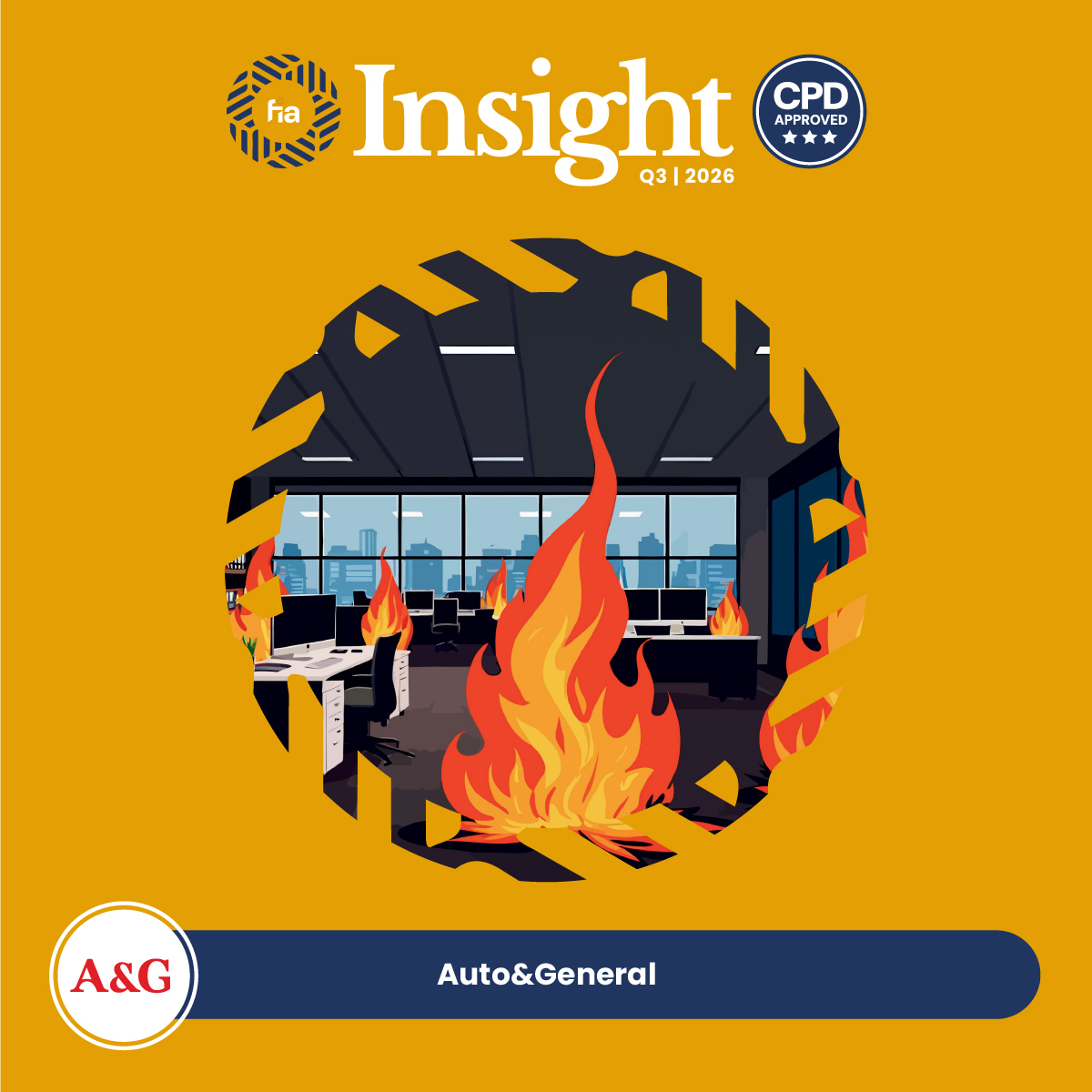
Emerging industry data estimate that fire losses in South Africa exceeded R8.8 billion during 2024, with fires at industrial and commercial properties accounting for more than R1.6 billion of those losses*. Insurers and brokers are paying closer attention to how fire risks are mitigated and managed, for good reason.
For Auto&General, the focus for business is twofold: It’s about the risk management that goes into identifying, assessing, and controlling the fire-related exposures a business faces, and it’s about having the right insurance cover in place to rebuild and recover should the worst happen.
“A fire is not a single event to insure against and cannot be treated as a stand-alone insurance conversation. Fire risk sits squarely within business continuity management. It’s not just about preventing loss, it’s about ensuring the business has a credible plan to keep functioning, or resume functioning quickly, if a fire does occur. The business continuity conversation is equally important to SMEs as it is to large corporate businesses, and in many respects, small businesses are more exposed to the knock-on impacts of a fire. It’s not just about the loss of physical assets. Small businesses typically have less financial buffer to absorb a loss, less capacity to operate from a second site, and far less room to survive an extended period without income if a fire guts their operations. For an SME, getting their fire response plan right, backed by a comprehensive business insurance plan is fundamental to recovery,” explains Carl Coetzee, Executive Head: Distribution at Auto&General Insurance.
Identifying and Anticipating Fire Risk
Every business, from a small retail outlet, to a beauty salon, an auto-repair workshop, to a manufacturing plant, carries fire risk that is specific to its operations, premises and location. A thorough risk assessment identifies where the exposure lies – in flammable stock and packaging materials, in production processes and nature of work, in building occupancy, or even a building’s proximity to other high-risk occupancies.
Understanding the impact of changes in the operating environment is equally important. As just one example, many businesses have installed solar power systems. This changes the fire mitigation measures considerably, especially where lithium-ion battery storage is installed. Standard fire extinguishers will have little impact on containing a lithium-ion battery fire which needs Aqueous Vermiculite Dispersion (AVD) to encapsulate the battery to limit the chemical reactions and prevent thermal runway from igniting adjacent battery cells. Solar panels installed on rooftops also increase fire risk due to the concentration of combustible materials such as roof insulation, cabling, roof trusses and so on.
Similarly, a landlord that changes the occupancy of their building – for example from office use to being leased out to a pop-up retailer – fundamentally changes the nature of the business risk and the compliance with fire regulations and insurance underwriting requirements.
Compliance with fire protection requirements lays the foundation of a risk management strategy. Businesses are required to have the fundamentals in place: sprinkler systems, hydrants, hose reels and other protection measures suited to their risk profile, occupancy, nature of work and underwriting requirements.
But even the best prevention measures can’t always eliminate the risk entirely. This is where early detection and response are critical, coupled with the right insurance cover.
Response: Every minute matters
A fire risk management plan must cover prevention, as well as early detection and rapid response. When a fire does break out, the first few minutes determine the scale of loss. This is why rapid response prevents a fire spreading beyond control is a critical consideration for businesses, insurers and risk advisors.
According to Zander Bartmann, General Manager at Fidelity Services Group, fire risks are increasing in frequency and severity.
“Our SecureFire teams responded to 1,592 fires during 2025 – on average 4.3 fires every day. In the first quarter of 2026, the number of fire incidents increased by almost 250%, with over 70% of these incidents occurring at commercial business premises. We have 733 dedicated private firefighting response units operating across metropolitan areas and smaller areas within South Africa, with an average response time of just 15 minutes, allowing us to respond effectively, while augmenting and reinforcing the efforts of local council and public fire services. By being first on scene with trained responders and real-time information, we stabilise incidents early, secure environments, and create a safer, more coordinated response platform for all parties,” adds Bartmann.
Auto&General has partnered with Fidelity SecureFire, giving its commercial customers in major metros access to South Africa’s largest private fire response network. Through its Fire Assist benefit, business clients with combined fire, contents and buildings cover can call on a private fire response unit to contain and limit losses at their premises or its boundary.
Recovery: rebuilding the physical and financial losses
Even with strong prevention, compliance and response measures in place, fire can still happen and the impact is always sudden and underestimated. Having the right insurance cover for both physical assets and business income is crucial for recovery.
“The first layer of recovery is the physical one: rebuilding or replacing damaged buildings, stock, equipment and infrastructure. This is the more visible and commonly insured side of fire risk. The second layer, and one most often underinsured or overlooked, is business interruption. If a business cannot trade, manufacture, serve clients or access its premises, income stops while costs, rent, salaries, loan repayments, continue. Business interruption cover bridges this income gap. It needs to be structured correctly with an indemnity period that reflects how long recovery will realistically take, not just how long rebuilding and replacing the physical assets might take on paper,” explains Carl.
The value of the insurer, broker and client relationship
This is where the relationship between insurer, broker, and client earns its value. Insurers bring underwriting expertise, claims processing capability and financial muscle to replace what is lost. Brokers bring understanding of the client’s specific business and professional advice that translates complex cover into practical protection that business owners may not even realise they need. The client brings knowledge and understanding of their business and operating environment that inform the risk management strategy.
When these parties work together, fire risk management becomes a continuous, collaborative process rather than a once-off policy purchase. That collaboration is what allows a business, whatever its size, to move from simply being insured against fire to being prepared for it. It is that preparedness that determines whether a business can survive a fire, recover from it, and grow again afterwards.